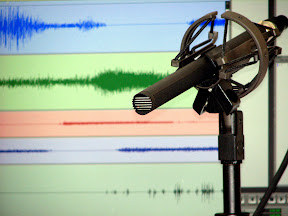
So I don't run a full both out of my home (apartment) anymore. I do so much work around town, that I can usually find a dedicated recording space with just a little heads up notice. I still do the odd recording at home from time to time, but the bulk of the work I do at home is editing.
I was really excited moving into our new place, as we now have central air, and my little workstation is kind of tucked away right under a vent. I'm a small guy, but I tend to overheat when sitting in the same spot for too long.
So imagine my dismay, when on my first editing job in the new place, I found myself sweating like a pig. With the AC set to 70 degrees. Mrs. Audio Guy turning blue...
Yesterday, I think I solved the problem.
I dismantled the lighting fixture above my head (low ceiling) to find two 120 watt light bulbs. It took the glass bowl about 45 minutes to cool down enough for me to un-screw it.
I popped in two CFL's, and I've drastically cut the temperature coming down on my head.
Maybe save a little power (and money) to boot!
Just a word of warning though. I don't know that I would recommend CFL's for actual booth set ups. CFL's do "hum", which could impact recordings. YMMV...
Picture courtesy of Brandeis University, which also has a handy little chart comparing the total cost of ownership between incandescent and CFL light bulbs.
Hey all, just wanted to point out the new RSS subscription links on the sides of the blog. I finally got around to signing up for Feedburner, so hopefully my blog will be a little easier to subscribe to.
There are two main ways to subscribe. If you use an RSS reader (like Google Reader which I use and love), then click on the subscription button:
You can click above or on the link above my profile.
If you don't use a reader, then you can also subscribe via email, and posts will be sent to you auto-magic-ally! Handy!
And lastly there are now a series of links at the end of each post for services like Stumble, Digg, Facebook, and more. Help spread the voice over love!
As always, thanks so much for checking this blog out! Questions, comments, requests are always appreciated!
I didn't jump on the bandwagon the last time he went and did this. I just didn't care that much about Imus.
I did feel sorry for the Rutgers Women's Basketball team, having their accomplishment crapped on by this ignorant yutz, but I could give two shits about Imus.
Didn't he say he was going to be better? From TechLuver (just after he returned to radio):
Imus apologized Monday again to the players. “I will never say anything in my lifetime that will make any of these young women at Rutgers regret or feel foolish that they accepted my apology and forgave me,” he said. “And no one else will say anything else on my program that will make anyone think that I didn’t deserve a second chance.”
So after everything he did to diffuse the previous situation, convince people he's not all bad, just an entertainer who made a mistake, he goes and pulls this.
Don "Imus -t be a MORON" talking about Adam "Pacman" Jones 6/23/08:
THAT'S NOT COMEDY! There's no reasonable way, that you could mistake that as an attempt at humor. What a jerk!
I'm not morally outraged, or offended by this comment. Adam Jones is a big boy. I'm sure his feelers aren't going to be hurt by this. I don't think we need to protect the children from comments like this.
I'm pissed they keep giving this bigot chucklehead air time.
Is there really NO ONE ELSE they could put on the radio? There's really not ONE soul, more apt for AM radio than this freak? Is the market for people who enjoy xenophobic racial slurs about athletes so flush with advertising dollars, that we NEED Imus (and only Imus) to satisfy them?
It's time. He's done. I think we can safely leave the slurred warbling of this sad pathetic individual, and move on to a real host now. Pls-K-Thnx.
Freak show is over. Nuthin more to see here folks...
It's some of the most creative mash up I've ever heard. I'm a couple days behind on this one, but I took a little time to give it a listen. Twisted, imaginative, frenetic, fast, it's Girl Talk, and for a "pay what you want" it's totally worth checking out.
any price grants the download of the entire album as high-quality 320kbps mp3s $5 or more adds the options of FLAC files, plus a one-file seamless mix of the album $10 or more includes all of the above + a packaged CD (when it becomes available)
That's not a bad deal ($5 for FLAC), and if you dig on mashups, I don't really think it gets much better...
SANTA MONICA, Calif. (AP) — A publicist for George Carlin says the legendary comedian has died of heart failure at a hospital in Santa Monica, Calif.
Jeff Abraham says Carlin went into St. John's Health Center on Sunday afternoon, complaining of chest pain. Carlin died at 5:55 p.m. PDT. He was 71.
Carlin, who had a history of heart trouble, performed as recently as last weekend at the Orleans Casino and Hotel in Las Vegas. It was announced Tuesday that Carlin was being awarded the 11th annual Mark Twain Prize for American Humor.
The dean of counterculture comedians, Carlin constantly pushed the envelop with his jokes, particularly with a routine called "The Seven Words You Can Never Say On TV."
I make no bones about the fact that I am a voice over director first, and recording engineer second. What's neat about working in voice over, is I get to be a talent from time to time.
I know the guys who are starting up CompleteParentalControl.com, and I was asked to check out their script (I used to write a little radio). They wanted to cut their web demo from 6 minutes to about 4. I tried cutting down their script, and then on a whim I recorded myself on it just to see how the changes sounded.
Well they liked my recording. I'm now the voice of their website!
OK voice actors. I've got a bone to pick. This is going to be a longer post (rant), but please read through, gimme your thoughts, maybe we'll all learn something.
I regularly run into actors who don't know what they're doing in front of the microphone. Actually, to be fair, they often know what it is they're doing, but they rarely know why they do it. A prime example of this is the proximity effect.
Loosely put, the Proximity Effect states that the closer you get to a directional microphone the more pronounced low frequency sound will become. This is a good thing for a VO person to know. Need to enrich the voice a little, well, move a little closer. Neat! Now we can all sound like James Earl Jones! Woot!
Yeah, but no...
I find this little "trick" is almost always misused, over used, or done incorrectly. I'll be in the middle of a casting session, mics set up for the talent, pop screen appropriately placed for a good sound, and what's the first thing the talent will invariably do? Smash the screen right up on the grill of the microphone. The idea being that if they are lipping my mic, they'll sound big and rich and full.
While true to a point, the human voice really isn't deep enough to warrant being that close to a mic. After a certain distance, you're not making your voice any rich-er or full-er. You know what you are doing though? You're rendering the pop screen almost completely ineffective, opening your recording up for all kinds of plosives, and possibly damaging the diaphragm of the microphone.
See, pop screens work by diffusing, redirecting, and reflecting puffs of air. By moving the screen right on top of the mic, air passing through the screen doesn't have a chance to be redirected, and will end up hitting the mic's diaphragm. Hello 'P' pop!
We've been down this road before too. In the late 60's, Neumann was getting a lot of microphones sent back for failure. Click on the picture for the service bulletin they put out regarding the increased failure rate. When working at distances of millimeters, those little puffs of air can create substantial pressure and concussive force on the microphone. Add in a greater likelihood of moisture (from breath and spit), and the possibility of contaminants (like the build up from a smokers lung), and it's incredible these mics last as long as they do. Give it a read (pic courtesy of micshop.com).
This brings up another quick point. If I'm running a busy casting session, how often do you think I'm able to clean that screen? How many people do you think will be recording off of it? I was already a germ-a-phobe before doing so much booth work, now... [shrug]
Also I'm not sure the "proximity read" is really helping people accomplish what they want, like booking more jobs. What's often the first thing we see on audition copy? "We're looking for a real person", "non-announcery", "no DJ voices". By reading so close to the mic, you're creating the technical version of the sound producers say they don't want, namely a big fat voice that feels like someone is talking at you, right between you're eyes. There's nothing natural about this sound. There's no sense of space, of this character you're creating being a real person in a room talking to the audience.
This has become more and more of a problem with the partner reads I need to audition. Lately it's become a race to see who can swallow their mic the fastest. After calling the group in, there's an instant flurry of activity as the actors position themselves on their mics, so there's no possible way they could ever really relate to each other and, you know, act. The result is often a very sterile "I'll wait for the other guy to stop speaking so I can say my line" audition. That doesn't book. People who sound natural and can riff book. The proximity read in a partner setting makes you sound unnatural at best, and at worst selfish, especially if you have a partner that isn't joining you in lipping the mic.
Just to make that pairing competitive, I now have to create conflict by asking the actors not to do what they're doing. I've yet to find a one size fits all solution to asking an actor to act instead of swallow my mic. I tend to get attitude, or a response that might seem to indicate that they think I don't know what I'm doing. Why wouldn't they want their voices to sound big and fat?
Sigh ... Right lesson, wrong time...
At the end of the day, the proximity effect is just that, something you do for effect, not all the time.
When you proximity read, make sure you're doing it right: *Mashing the screen on the mic increases the likelihood of plosive (and damage). At the closest there should still be about a "thumb's" distance between screen and grill. You better have a good reason to be in that close! *When you're that close, a little off axis work (turning the mic at an angle) will still sound great, and help tame those puffs of air. No reason to face in flat on the mic. *Low volume reads only! Trailer style reads are actually some of the quietest reads there are. *Absolute no-no for partner work!
Still need more convincing than a booth director working in the trenches every day? Well how about the biggest proximity readers there are! This is a clip I recorded off the Today show a YEAR ago featuring Don LaFontaine, Joe Cipriano, Mark Elliot, and George Delhoyo.
I've added annotations to the video, so you should see boxes pop up highlighting the actors on mic (keep your mouse cursor on the video to see the annotations). George comes closest, but NONE of them lip the mic.
Sorry to lay it on so thick, but I've been fighting this one a lot lately. Leave me comments guys and gals. Whaddaya think?
For those of you looking for ISDN like recording over the internet, look no further than Source Connect. It allows you to send your audio anywhere in the world (with broadband access), in real time (usually with very little lag), and allows you to be recorded on the receiver's end (provided they have SC). The nice thing about SC is it doesn't require you to purchase any other equipment to add to the recording chain. You don't need to route back and forth from a Telos Zephyr. Everything is handled internally by your computer and soundcard. It's these kinds of technologies that are a god send to voice actors across the country. It means you're just as competitive in Poughkeepsie as you would be in NY/LA/Chicago. As ISDN slowly starts to die off (wont happen for a while yet but still), these audio connection technologies are going to have to step up to fill the gap. Especially as it seems that ISDN support is getting harder to find, and ISDN lines are becoming more expensive in some areas.
Source-Connect 3.0 is not compatible with 2.5. Current 2.5 users must upgrade to 3.0. Due to a number of internal improvements Source-Connect 2.5 and Source-Connect 3.0 are not compatible. All current 2.5 license owners are eligible for a free license upgrade.
I think this is actually kind of cool. So often with software, compatibility issues seem to only be discussed in the darkest of forum threads. Kudos for putting this right out in the open and saving us all the search. Also making the update free is a really classy thing to do. I get really tired of paying for '.1' upgrades (Apple and Pro Tools I'm looking in your general directions). Considering they are acknowedging that their upgrade breaks compatibility with their own previous version, making the update free is really appreciated.
So come on SC users. Lets get to updating, so we're all on the same page!
And you closet junkies, needing a remote recording solution or phone patch, check it out!
I'm a big ol nerd. Don't care what you say. Astro Boy is teh awwsum...
I'm pretty stoked for this movie. Imagi Studios is producing, and I thought they did a fantastic job with the look of TMNT (that and I'm pals with "Donatello" so I'm a little biased lol), and I think that's exactly the kind of treatment a property like Astro Boy should get. I'm really happy they decided against a live action film. Unlike say, a certain Speedy film about a car Racer that may or may not have been recently released.
Slated for worldwide theatrical release in 2009, "Astro Boy" will feature the voices of Academy Award®-winning actor Nicolas Cage, Donald Sutherland, Nathan Lane, Bill Nighy and Eugene Levy with Freddie Highmore in the title role. David Bowers is directing ASTRO BOY from a screenplay written by Timothy Harris, with Maryann Garger producing.
I have to say, that cast looks pretty great. David Bowers is an ... interesting choice to direct (I'm pretty sure his last film was Flushed Away), and I'm curious to see how he handles action.
Astro Boy Rawks! I'm really looking forward to seeing how this turns out.
The father of the dinosaurs in JURASSIC PARK, of THE TERMINATOR, of PUMPKINHEAD, PREDATOR, the Monsters in MONSTER SQUAD, and of course ALIENS, has passed on.
So, let's say you need to get some spying done, but you have a VERY small budget, and those surveillance stores really creep you out. If you have a Mr. Microphone lying around, then prepare to start listening in on other people's conversations!
I'm doing the math in my head for what it would take to use an old FM Transmitter I have (those things never work well in cities). Hmmm.... In-ter-est-ing...
Oh hell, just for kicks here's the Mr. Microphone commercial I love SO much.
So this is following up on the theories of cloaking objects from the visible light spectrum, that if you can get acoustic energy to flow AROUND a structure, then the inside of that structure is essentially acoustically neutral.
Scientists have shown off the blueprint for an "acoustic cloak", which could make objects impervious to sound waves.
The technology, outlined in the New Journal of Physics, could be used to build sound-proof homes, advanced concert halls or stealth warships.
Darpa had a similar project running in 2007 to try and reduce acoustic energy from military vehicles, but I think this current project from Spanish researchers could prove more effective. It would also have more immediate consumer benefits (as well as more practical application for the Navy), though probably less effective for ground based vehicles.
Or maybe it would be too good. It might not be such a good idea to make a completely sound proof car...
On Coast to Coast with George Noory: Anne Serling (daughter of Rod) and writer Marc Zicree will talk about Rod Serling's induction into the Sci-Fi Museum Hall of Fame.
A reader just sent in this BBC News article where U2's manager declares the experiment a failure:
The majority of fans who downloaded In Rainbows ignored the band's website and acquired it illegally by other means, Paul McGuinness told BBC 6 Music.
"Sixty to 70% of the people who downloaded the record stole it anyway, even though it was available for free."
U2's next album - due this year - would not follow the same approach, he added.
Ummm-Kay... First off, I don't get how U2's manager gets to make this declaration. Even if the numbers are accurate, this perceived theft would probably have fallen in line with the number of people who would've downloaded the album for free any way. I know I had SERIOUS problems even accessing Radiohead's site the day the album went live.
Next the goodwill generated is completely incalculable. The spectacle of releasing a commercial work of this quality for free probably reached farther out than just Radiohead fans. I had quite a few friends who weren't Radiohead fans before, but enjoyed In Rainbows enough to check out their earlier work. I'm assuming there was a subtle "Napster effect" after In Rainbows release, with earlier albums experiencing a small sales bump. Add that exposure to concert ticket sales, and sales of the hard copy of In Rainbows, and I think the download experiment has helped the band a lot more than some estimated loss of units sold could hurt it. I found the last line of the BBC story telling:
The album went straight to number one in the UK and US when it became available on CD in January.
And speaking of "Napster effect" Metallica seems pretty resolute about continuing on their march to complete irrelevance.
Just after drumming up some buzz by embracing iTunes, and talking about trying their own NIN like download album release (making them the greatest flip-floppers of all time imho), they go and pull a stunt like this. Ars is reporting on the bands inability to NOT piss off all of their fans who happen to use the web. First they invite music critics to review 6 tracks off their new album (I didn't even know there was another album in the works). Then they send the critics and bloggers off to write stories about those tracks. THEN the band's management threatens the bloggers who wrote reviews, and bullied them into taking those reviews down. Then the band makes an "official" statement on their website saying:
"Our response was 'WHY?!!! Why take down mostly positive reviews of the new material and prevent people from getting psyched about the next record... that makes no sense to us!'"
OK.
I stopped listening to Metallica after they embraced the litigious nature of the RIAA, and were brutally public about suing all of their fans. It was a sticky situation, and file sharing is stealing (not piracy though), but this was the wrong move to make. If they're played on the radio I change the station. The fact that they are considering following NIN and Radiohead, proves to me that their reputations (along with their album sales) have been damaged to the point where they need to eat some crow, make a magnanimous gesture. Great. Good for them.
This latest episode just shows that they still don't know what the crap they're doing with this whole intarweb thing.
The thing about DVR's is I tend to collect Daily Shows for weekend viewing, and I almost missed this segment, so pardon as I'm a little late to this party.
I think it's great that McLellan was brave enough to narrate his own book, but lets just say that it was a good thing Stewart had some help from Fred Schneider of the B-52's.
Just got an email from an executive working for MTV in the UK, alerting me to their new "Engine Room" reality show competition.
From Steve in the UK:
Hi there, I work for MTV in the UK. We're currently recruiting for a new show that will be filmed in New York this summer. We want talented young sound designers to join us in the Engine Room, a creative space where four teams (Europe, the US, Asia and Latin America) compete for a chance to win a top prize of $400,000US Dollars in cash plus HP gear. The show films in New York starting 17th of July, and lasts for four weeks. Although it's a reality show, it's also a great chance for new talent to stand out from the crowd - and $400,000 is a decent kick start to any career! We thought this would be something your readers might be interested in and wanted to ask you to feature it on your blog. Full details are available at the website - www.mtvengineroom.com - please let us know if you feature it and don't hesitate to get in touch if you want any more info.
Thanks loads,
Steve
You're welcome Steve. I just checked out the site, and it looks pretty intense. The prize list is awesome.
I wonder if there's room for a sound designer in the competition...
Heaven forbid we get an honest opinion out of someone in this information age, right?
The accent doesn't hurt either...
We all know this has been a big deal for me. Performance capture will become more and more important as we cross through this uncanny valley that we're in right now, and quality performance has been championed by others as well, like Adam Sessler.
This review doesn't hinge on voice acting. But in a game as HUGE as Oblivion (estimated to have HUNDREDS of hours of game play), keeping the player engaged is crucial. Having a limited number of performers, with poor writing, and poorly directed performance, makes this immersion SO much harder.
Gamers ARE paying attention to this, and Yahtzee nails it!
Here's his review. It's funny (savage and savvy), and I agree wholeheartedly. Portions (as always with Yahtzee) might be inappropriate for younger viewers or NSFW.
If you live in California's 71st Assembly District (Riverside and Orange County), you might (or already may have) receive a call from Tony Bedolla supporting Neil Blais for Assembly. Now Blais IS a Republican, but I wont hold that against Tony, LOL.
Not bad at all! Professional, concise, clear, I wonder if I could get Tony into radio instead of stumping for a GOP Assemblyman. Hmmmm....
Oh wooops! My Liberal is showing!
Ahem...
Here's more info on my Uncle, Tony Bedolla. I'm really proud of him!
Tony Bedolla Alternate Safety Board Member
Term: 04/22/2008 - 12/31/2009
Tony Bedolla was certified to serve as Alternate Safety Member by the Orange County Board of Supervisors on April 22, 2008. He brings a wealth of experience to his new position as a member of the Board of Retirement.
Tony has served as a firefighter with the Orange County Fire Authority since 1991. He is currently assigned to a paramedic engine company protecting the citizens of Villa Park.
In 2001, Tony was elected to the Board of Directors for the Orange County Professional Firefighters Association. His current responsibilities with the organization include that of Director of Government Affairs and Recording Secretary.
In addition, Tony has a Bachelor of Arts degree in Economics from the University of Southern California. Before coming to the Orange County Fire Authority, he worked in financial/scheduling capacities for two aerospace companies (Rockwell International and Northrop Corporation) for a total of 11 years.
Now, I don't claim to be a microphone expert, but I've been a round the block a couple times. So while trying to find a good deal on an AKG c414 EB, I've been scouting more on craigslist and ebay.
What a virtual wasteland ebay has become.
First off, I'm really tired of people posting new stuff to sell. An AKG search pulled up more "stores" than anything else. MINT NIB NR WOOT!!! The number of "buy it now"s is kind of REALLY obnoxious. Why would I want to pay full retail, inflated shipping, and CA sales tax, when I can just go to Amazon?
Secondly, I'm tired of all the yahoos there that jack prices up WAY too high for used gear. Really?!?! $70 for a used MXL 990, PLUS $15 to ship?!?! I'll buy it new for $60 (including shipping) ANYWHERE else, thanks. Hell I got mine for FREE with a $200 soundcard!
I've been getting my hands on some really fun old mics. First the SM56, then the MD421-U-5, and now this AKG D202 "Rocket".
This mic was given to me from a friend who runs a studio. Sat in a box, it didn't sound all that great (compared to the Neumanns they use), and no one even knew what it was as all the badges ("we no need no stinking BADGERS!") and labeling had been torn off. Add to that, it also didn't fit in ANY standard sized mic holder, and just to use it they had to rig a shotgun shockmount. No fun at all...
So they gave it to me!
The D202 is an odd little duck. First manufactured in 1966 (I have no idea when this particular mic was made, as there are no serial numbers), it was AKG's first dual element microphone.
High frequency sound is captured under the nose cone, low frequency sound captured by the XLR connector, and the two elements communicating over a cross over which runs the length of the mic. This process leads to a directional mic with almost no proximity effect. It also seems to lead to a more fragile mic, with many complaints online of D202's being sold with busted LF elements.
The mic's design SCREAMS 1960's. They don't call it "The Rocket" for nuthin. The vents in the tail are actually functional, aiding in low frequency accuracy, and the nose cone is made of sintered bronze, creating a built in pop/spit/dust guard. I don't even know what sintering IS! [Sintering is a method for making objects from powder, by heating the material (below its melting point - solid state sintering) until its particles adhere to each other. Sintering is traditionally used for manufacturing ceramic objects, and has also found uses in such fields as powder metallurgy. -- Ed.]
So how does this D202 sound?
Well, considering the amount of damage, not bad, and surprisingly the LF element is functional. I broke out some Aesop this time, instead of my usual Poe, and did a comparison between this Rocket, and my new dynamic sweet-heart the MD421-U-5. I recorded dry, directly to my FW410, approximately 3 inches from the grill/nose of each mic. I did compress in post, then mixed down to 320Kbps MP3.
MD421:
AKG D202:
Yup, this mic has NO PROXIMITY. I sound a lot thicker on the MD421 at this distance. Even though the low frequency element is working (I confirmed by rolling through the bass cut), I sound a little hollow. I think the D202 is a little closer to accurate, but reality is probably somewhere in between the 421 and the 202. Again, the MD421 shows what a champ it is dealing with plosives, the 202 suffering through almost as much as a naked SM57.
Off axis rejection was about equal surprisingly enough. That's pretty impressive considering the the D202's lack of proximity. I'm surpised we don't see more specialty mics using this process, as it works REALLY well. Could it be an issue of durability?
In all, I was surprised at how well the AKG did. Through scrapes, scuffs, and a big ole dent in the nose cone (probably from a fall that dented the bronze), it's still got a usable sound. I don't think it's particularly honest anymore, but as an effect mic, or on certain voices or instruments, it still delivers an interesting sound.
Two last notes.
I found the mic holder that I got with the M-Audio Aries is a PERFECT fit for the D202 if you're missing the original mic clip.
Trent Reznor offers another free download: A 'Tour Sampler' featuring songs from bands performing on the upcoming Nine Inch Nails tour. Included are tracks from A Place To Bury Strangers, Does It Offend You, Yeah?, Crystal Castles, Deerhunter, and Nine Inch Nails. Once again, 100% free, high quality MP3s, DRM-free.
Congrats to the cast of The Simpsons! Deal negotiated without Fox execs (jerks) threatening to replace them (they're just voices right), like in 1998 when they hired casting directors to replace voices (or how Tress MacNeille's roles showed up in my hands before The Simpsons Movie). You're now paid ALMOST HALF what you're worth!
Missed this story from a couple weeks ago on IO9, about the passing of two great sci-fi soundtrack composers. Bebe Barron who scored Forbidden Planet (AWESOME flick), and Alexander Courage who scored the theme to Star Trek. Great post on IO9, I just find it a lil creepy that the Federation in ST is loosely based on Forbidden Planet...
At least according to researcher Shannon Harris...
BBC News is reporting on a study, where the qualities of a person's voice (tone, frequency, rate of speech, breathing) can be charted to determine where one might fall on a pleasant scale. There are many objective qualities to be taken into consideration, but I'm not wholly surprised by this. Just as we generally determine physical beauty based on certain attributes, like symmetry, the idea that we can mathematically determine what frequency and pitch a voice should have to be considered "pleasing" isn't too far fetched to me.
So who did UK researchers pick as having "perfect" voices?
I have to say THIS did surprise me just a little. Apparently Alan "and cancel Christmas" Rickman has an ideal male voice. This is interesting to me, as I find his voice is a touch nasal, but I can't help but listen to every word he says, usually with rapt attention.
Which voice should women be aspiring to? Look no further than Dame Judi Dench!

 I dismantled the lighting fixture above my head (low ceiling) to find two 120 watt light bulbs. It took the glass bowl about 45 minutes to cool down enough for me to un-screw it.