In Atlantic v. Howell, Judge Neil V. Wake denied the labels' motion for summary judgment in a 17-page decision (PDF), allowing the suit to proceed to trial. The argument--that merely the act of making music files available for download constituted copyright infringement--has been the basis for the Recording Industry Association of America's legal battle against online music piracy.
Yup, I'm plugging family! My Uncle Stefan and Cousin Lauren are in the running for an appearance on the new Bobby Flay show on the Food Network.
I guess show biz is in the blood, because they did a great job. Check it out:
So, I need everyone to go hit THIS LINK and lets bump this rating up!
Oh, and Uncle Stefan, I can see your lips following along with Lauren's lines. This is a BIG actor no-no. We'll work on it when you're ready to make your run on LA, LOL!
We're saying goodbye to WeHo, and heading out to Studio City. I probably won't be updating as often over the next week, as we have a LOT of work to do.
So this article strains way to hard to make the Hitler connection...
Ok, it's still a good read though.
NPR has posted an article up about John Peluso, a boutique microphone manufacturer, whose not only trying to replicate the look, but also the sound of classic microphones. As a studio engineer, John worked on Sony's, AKG's, RCA's, and Neumann's, and learned quite a bit of his craft from Verner Ruvalds (a physicist responsible for the bottle mics popularized by Hitler's speeches).
Of course the article focuses on that, and it is kind of chilling to think how Nazi propaganda was tactically planned down to the micron measurements of their microphones (there's probably a lesson in there somewhere buried in our villification of history),though I can no more blame Neumann for the rise of the Nazi party than i can Volkswagen...
Anywho, the actual history of this article is fascinating, and I'm seriously going to consider getting my hands on some Peluso Microphones.
Having just finished fixing up an SM56, it's kind of crazy to think that as these engineers are passing away, we're losing the knowledge to create these sounds. Kinda crazy, kinda sad...
Here's the Peluso Microphone web site. someaudioguy some audio guy microphone voice over recording vo voiceover demo production history engineering restoration vintage tv film radio broadcast
Several tech/gadget blogs and news sites are reporting on the back and forth legal letters between Monster and Blue Jeans Cable. BJC is a very small company that makes A/V cables, and as far as I can tell they manufacture in the USA (woot). Apparently Monster thinks that only they should be allowed to produce shielded RCA cables. They've sent a C&D letter to BJC over what they claim is patent infringement on their design.
Let's take a look: Huh?
[sarcasm] Gee, I had a REALLY hard time figuring out which one was the Monster cable (what with the one cable having the BIG MONSTER LABEL on it)[/sarcasm]. Picture courtesy of Gizmodo.
Well the owner of Blue Jeans just happens to be a retired copyright lawyer, and his 3200 WORD response to Monster's letter is both brutal and pants-wettingly hysterical. I wont quote the whole letter here, but this was my favorite bit:
I will also point out to you that if you do choose to undertake litigation, your "upside" is tremendously limited. If you somehow managed, despite the formidable obstacles in your way, to obtain a finding of infringement, and if you were successful at recovering a large licensing fee--say, ten cents per connector--as the measure of damages, your recovery to date would not reach four figures. On the downside, I will advance defenses which, if successful, will substantially undermine your future efforts to use these patents and marks to threaten others with these types of actions; as you are of course aware, it is easier today for your competitors to use collateral estoppel offensively than it ever has been before. Also, there is little doubt that making baseless claims of trade dress infringement and design patent infringement is an improper business tactic, which can give rise to unfair competition claims, and for a company of Monster's size, potential antitrust violations with treble damages and attorneys' fees.
So to wrap up this already WAY too long post. I just started watching today's Tekzilla, and Patrick Norton had quite a bit to say about how he felt about the situation. He says boycott, and who am I to disagree. I've been tired of their price gouging for years, and every time I see gold plated, $60, six foot USB cables, it makes me want to hurt kittens. As soon as I'm done with this post I will be removing all Monster products from Some Audio Store.
Check out what Patrick had to say (very beginning of the show):
I would highly encourage anyone looking for A/V equipment to seriously consider ANY alternative to Monster. Blue Jeans is fighting the good fight, I've always had very positive experiences with Monoprice, and for you recording folk I think Mogami Microphone cables are some of the best XLR cables you can get your hands on, and George L makes fantastic instrument cables at very reasonable prices.
And if you're really in a tight spot, Monster cables sound about as good as a wire coat hanger(wire coat hangers soon to be really expensive at Best Buy), so there you go... ***UPDATE 4/19/08*** My blogging pal Brandon Drury is joining in on the boycott as well. He runs the Recording Review, which is an excellent source for recording information, especially those wanting to get into engineering. You can check out his boycott blog post here: I Will Never Buy Another Monster Cable someaudioguy some audio guy voice over voiceover vo demo production animation recording acting producing equipment microphones cables engineering
In case you need to catch up here are Epsiode 1 and Episode 2! someaudioguy some audio guy animation voice over voiceover recording foley adr dubbing read more | digg story
MICROPHONE! Digging through some of the old equipment at one of the casting studios I work at (the oldest voice over casting studio in LA Woot!) I stumbled on a box of old microphones. Most were crap, but tucked away was an original capsule SM56! Had to tinker with the impedance, but got it set up, and it's now enjoying full time use. Near as I can tell, the mic is almost 40 years old!
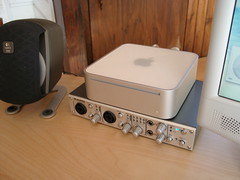
SOUNDCARD! I love Stumbleupon. It sucks so much of my life away, just stumbling round teh intarwebs. Caught this Flickr pic from sneeka2 comparing the Firewire410 (my soundcard) to the Mac Mini. I was actually kinda surprised.
I've been kinda disappointed in soundcards of late. Besides some of the Mixer/Interface hybrids, there's been depressingly little development. Is there anything you readers are looking forward to? Let me know!
SOUND PROOFING! For those of you trying to set up your own recording booths, check out this vid from the Revision3 Gazette, and you can see what they went through to reduce echo in their studios. Now obviously this is reinforcement on an industrial level, but the lessons here are still valid for us closet junkies.
someaudioguy some audio guy voice over demo production voice acting adr dubbing animation anime narration
If you were to play the same clip of audio at 320Kbps (the highest quality MP3 you can rip) and 128Kbps (about average, maybe a little below) would you be able to tell the difference? The 320Kbps file is 2.5 times bigger than the 128. Do you really get two and a half times the "quality"?
Ok, so all audio snobbery aside, I actually could tell the difference between the two samples on this site. It wasn't a huge difference, but there was a subtle feel to how the voice interacted with the instruments, and I was certain I had the right clip.
I have to say that comparing the two clips was pretty interesting. When I rip music now I only rip to 320Kbps or to FLAC. Mostly I'm just paranoid about not losing too much information (archiving CD's or if I ever need to re-rip), but it is kinda satisfying knowing that 128Kbps MP3's aren't quite as bad as us audio snobs make them out to be.
I'm feeling political, so why not combine that with the whole theme of this blog, you know, stuff you can hear...
Not much to say, but the site American Rhetoric has collected the top 100 speeches of American history, and linked to MP3's of the speeches along with written transcriptions. If you're a history/audio/political nerd like I am (what, maybe all 6 of you out there), then this is an awesome resource.
Noticeably absent from the list is one current Commander in Chief. If you're upset about that, why not make up your own bush speech with sound bites, and see if you can create something that'll make the American Rhetoric list. He obviously can't...
I'm SO STOKED for Iron Man, it's kinda silly. Robert Downey Jr is the PERFECT pick for Tony Stark. Gaming Today has a great behind the scenes video on the making of the Iron Man video game staring Downey. Check it out below!
Iron Man Behind the Scenes Video 2 - High someaudioguy some audio guy voice over demo production animation video games direction voice acting anime adr dubbing audiobooks narration
So earbuds are bad. Are headphones any better than earbuds? -B.A.K.
I guess I should clarify. It's not that earbuds themsleves are bad for you, it's how we use them that's the problem. In the past there has always been a limit to how much we can bombard our ears with directly. A tape would have to be flipped, a cd would be over in under an hour, double A batteries would run out, something would prevent you from being able to saturate your ears for too long. Now with mp3 players (with built in, all day lasting batteries) there's no reason not to soak your ears in sound all day and all night.
Earbuds (the cheap kind that normally come with mp3 players) SUCK for this kind use. They don't create ANY seal around the outside of the ear, so your music is competing with the noise in your environment. The only way to combat that is to turn the volume up higher. The louder the volume, the less time you have before you're doing subtle (but possibly permanent) damage to your hearing.
The alternative is to use ANYTHING with some kind of noise reduction. I like inner-aural earbuds (the kind with rubber or foam that go INSIDE your ear canal), but some people think they're uncomfortable. You could also check out headphones that have active noise removal (but that might mean keeping some batteries on hand). Regardless, if you can strip out the noise of your surrounding environment, then you can listen to your music at a lower volume, without sacrificing the quality of music (in fact, it'll probably sound better for it), which should give you more listening time before you exhaust your ears. Right now I use Sennheiser CX300's for listening to music, and Sennheiser HD25-1 II's for recording. I guess I'm just a Sennheiser kinda guy...
At the turn of the millenium, white earbuds were a fashion statement. Now? Toss em. They're crap.
someaudioguy some audio guy music recording voice over production voice acting demo adr dubbing headphones earbuds science health hearing
So, you should REALLY be watching PopSiren. I think it's one of Revision3's most ambitious shows yet (and Heather Frank is pretty bad ass). The show, hosted by Sarah Lane and Jessica Corbin, covers all manner of subjects from lifehacking to DIY, and Dr. Kiki covers a lot of "Mr. Wizard"- like topics (like making fire dance with sound waves).
In their most recent episode Dr. Kiki demonstrated how earbud headphones work. Being the A/V nerd that I am, how could I NOT be totally stoked. I've written about earbuds before, and was really happy to hear Dr. Kiki also warn her audience about the possible hearing damage associated with cheap earbuds.
Here's Episode 6 of PopSiren, but you should really subscribe to this show with something like Miro. Enjoy!
someaudioguy some audio guy music voice over hearing headphones recording equipment voice acting demo production adr dubbing
In 1913 John B Flowers invented a machine that could convert speech to typed text.
IO9.com has a great write up of the invention, and it's limitations.
There were "serious limitations which must be considered" with Flowers's voice-operated typewriter, chief among them its inability to distinguish between homophones like "to," "too," and "two"...
Expanding on IO9's post, I found a paper published by Mr. Flowers in 1916. It's a dry read, but pretty incredible reading through his analysis of the human voice. With all of our fancy software algorithms and powerful computers, we're really not that much farther along. If you're interested at all in the science behind how we make noise (recording engineers I'm looking in your general direction), then I would highly recommend reading through some of this. It's already given me some EQ ideas for my next demo production session.
And here's IO9's post: A Machine That Types What Is Spoken To It, 1913 someaudioguy some audio guy speech text dictation voice over production voice acting demo animation audiobook speech to text narration recording audio engineering Picture Courtesy of io9.com
Just like my post about Spacehog, when I get stuck on a song, I REALLY get stuck on it. Obsessive! I'm burning up my ipod on one track right now...
The song du jour is 'You've Got to Hide Your Love Away' from the Beatles movie 'HELP!', and I'm kind of loving it. I think it's a musical high point of theirs, in terms of simplicity, and is easily, hands down, my favorite Beatles song.
I love that it's not as literal as "Yesterday'. I love that it's disgustingly vulnerable. I love that John Lennon pops his p's on "people". I love that the recording is SUPER raw. It's hissy, and simple. Listen to the song on headphones with your eyes closed. It sounds like there's a guitar ten feet to your left, a tambourine ten feet to your right, John Lennon is about 5 feet in front of you, and at the end a ninja with a flute has snuck up behind you to finish the song off with a solo.
It's gorgeous.
It's kinda sad to think that a song as sweet as this could NEVER be made today...
Help! someaudioguy some audio guy music beatles voice over help voice acting demo voice casting film
But if I didn't write BOLD headlines, would you even be reading this?
Wired's Listening Post has a really interesting post up about a new type of music reproduction/digital compression. Unlike MP3 it doesn't work as a way of compressing and sampling actual sound, but as a way of reproducing the performance of the original. So really, in a way, I was being even MORE misleading with my post title, as this isn't so much competition for MP3 as it might be for MIDI.
So? We've been using MIDI for a while. What's the big the deal?
Well, checking out the samples on the post, the research team (using an actual recording of a clarinet) has been able to create a MIDI-like recreation of the clarinet, (which would normally be around 32KB in MIDI), but with this new method takes up less than ONE kilobyte (1KB).
For those of you like me, who weren't math majors, that's less than ONE THIRTIETH the file size!
I've gotten this question a couple times, so I figured it was time to throw some equipment at the problem.
Should you plug your mic directly into your soundcard (or mixer), or should you invest in a dedicated preamp?
The answer is "yes".
Either.
Correct.
Let's take a listen! For today's experiment, we're going to use my M-Audio Solaris because it's a decent budget condenser microphone, and it's become one of my favorite work horse microphones.
The two preamps we're going to compare it with are the Behringer T1953, which I've had for a while now...
...and, an ART Tube PAC, which I've only just recently acquired.
To keep everything as neutral as possible, I'm recording into my Firewire 410.
All recordings were done 6 inches from the mic's diaphragm, and have not been edited (unless noted) accept for compression to 320Kbps MP3 for streaming (initial recording were done @ 24/96). The PAC was used low threshold with 3:1 compression.
OK, so what can we glean? Well, none of these sound "bad" to me. I prefer the sound of the PAC, it's a little fuller than the direct to soundcard, but I still feel like that sounds like me, natural. The T1953 sounds "hotter" or "louder" (odd as it doesn't have a compressor like the PAC), but it adds a slightly unnatural timbre or edge to my voice. It's a subtle texture that's not unpleasant, but I don't feel that's what I really sound like. Also the T1953 adds a bit more noise to the chain than the PAC. The direct to soundcard is the cleanest of the group, but is also the plainest to me. It's not bad, just vanilla, and we all know that vanilla is the best "base" ice cream. I think this recording would probably be the easiest to EQ and mix in front of music on a commercial.
As with so much of what we do, if you're already working a mic you like with a good soundcard, then adding a preamp (especially ones like my budget preamps) isn't going to bring an earth shaking difference to your recordings. It can make editing easier however as it instantly brings up the level of your recordings, giving you a nice hot signal to work with, but it can also make editing harder if your preamp is noisy.
For us VO people, I can only recommend buying a dedicated Pre if you've compared a few, and you've picked one out that compliments your mic and soundcard in accentuating the qualities of your voice you MOST want people to hear.
And of course, everything in this article can be purchased through SOME AUDIO STORE, LOL! someaudioguy some audio guy voice over recording auditions VO voice acting equipment kit gear microphone preamp soundcard digital audio interface